The Problem Being Solved:
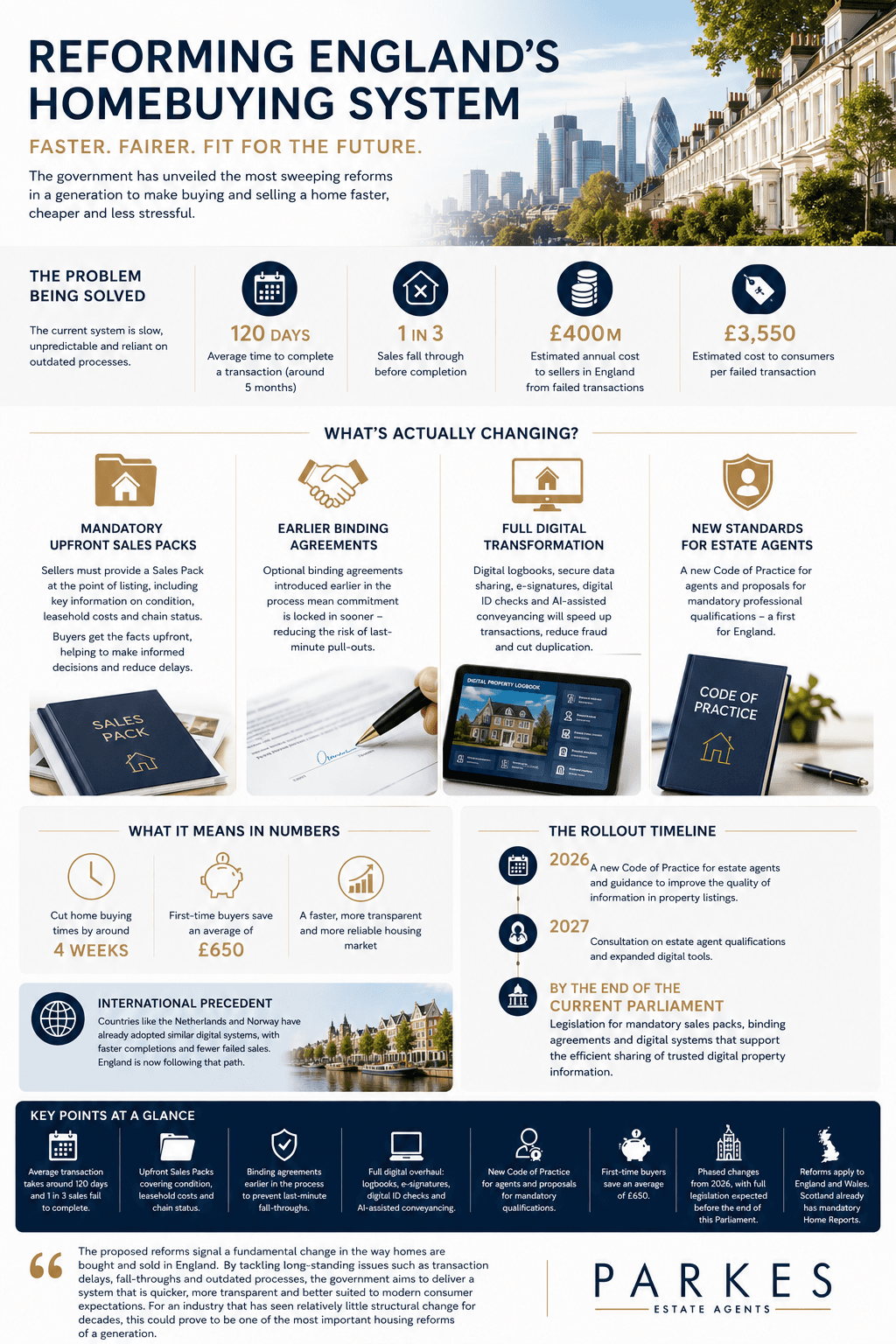
The current system has faced criticism for being slow, unpredictable, and heavily reliant on outdated processes. Transactions take around five months on average, and roughly a third collapse before completion. Government data shows that over 300,000 property sales fall through each year, costing consumers an estimated £3,550 per failed transaction once surveys, legal work and mortgage fees are factored in.
Failed transactions currently cost sellers an estimated £400 million every year in England alone.
What’s Actually Changing?
Mandatory Upfront Sales Packs:
Sellers and their estate agents would be required to provide a ‘sales pack’ at the point of listing a property for sale. This pack would set out key information about the home, including its condition, any leasehold costs, and where it sits in any property chain. In practical terms, sellers will need to commission a condition survey or provide equivalent verified material information prior to marketing, ensuring that prospective buyers can review key details before making an offer.
Earlier Binding Agreements:
Another major development is the introduction of optional binding agreements earlier in the transaction timeline. Under the current system in England and Wales, a sale only becomes legally binding at the point of exchange of contracts, meaning either party can walk away at any stage. The reforms seek to change that, locking in commitment far earlier and dramatically reducing last-minute fall-throughs.
Full Digital Transformation:
At the heart of the reforms is a major shift to digital, replacing outdated paper-based systems with faster, more reliable tools. Digital property logbooks and sales packs will allow trusted information to be shared securely between professionals and accessed by buyers and sellers in real-time. The government will also back digital identity checks, electronic signatures and AI-assisted conveyancing to strip out duplication, reduce fraud risk and accelerate transactions.
New Standards for Estate Agents:
The government intends to introduce a new Code of Practice for property agents and consult on mandatory qualifications for estate and letting agents. At present, somebody does not legally need to hold a professional qualification before working as an estate agent in England.
What It Means in Numbers:
The reforms are expected to cut homebuying times by around four weeks, save first-time buyers an average of £650, and get the housing market moving more quickly.
The Rollout Timeline
The reforms are being phased in gradually rather than introduced overnight:
2026: A new Code of Practice for estate agents and guidance to improve the quality of information in property listings.
2027: Consultation on estate agent qualifications and expanded digital tools. By the end of the current Parliament: Legislation for mandatory sales packs, binding agreements, and digital systems that support the efficient sharing of trusted digital property information.
International Precedent:
The Netherlands and Norway have already ensured a smoother process and have seen faster completions and fewer failed transactions after adopting similar digital systems. England is now following that path.
KEY BULLET POINTS AT A GLANCE:
• The average transaction currently takes around 120 days and one in three sales fails to complete, the reforms directly target both figures
• Sellers must provide upfront Sales Packs at point of listing, covering condition, leasehold costs, and chain status
• Binding agreements to be introduced earlier in the process, reducing the risk of either party pulling out after months of negotiation
• Full digital overhaul: logbooks, e-signatures, digital ID checks, and AI-assisted conveyancing
• A new Code of Practice for estate agents, alongside proposals for mandatory professional qualifications. This is a first for England
• First-time buyers stand to save an average of £650 under the full package
• Changes will be introduced in phases from 2026, with full legislation expected before the end of this Parliament
• The reforms apply to England and Wales. Scotland already operates a different system, where Home Reports have been mandatory for sellers since 2008.
The proposed reforms signal a fundamental change in the way homes are bought and sold in England. By tackling long-standing issues such as transaction delays, fall-throughs, and outdated processes, the government aims to deliver a system that is quicker, more transparent, and better suited to modern consumer expectations. For an industry that has seen relatively little structural change for decades, this could prove to be one of the most important housing reforms of a generation.
Share this article
More Articles



Sign up for our newsletter
Subscribe to receive the latest property market information to your inbox, full of market knowledge and tips for your home.
You may unsubscribe at any time. See our Privacy Policy.